
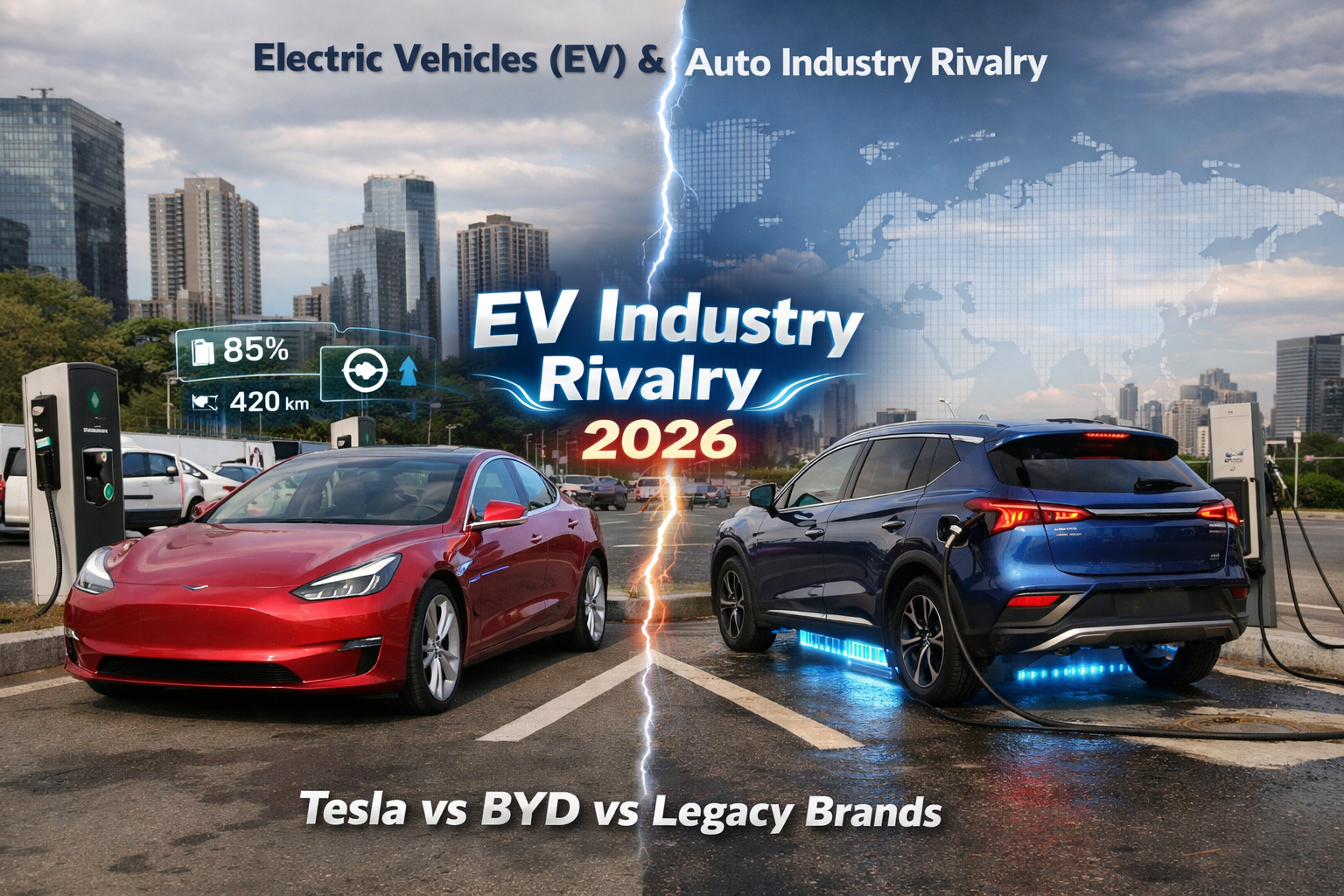
The Electric Vehicles (EV) & Auto Industry Rivalry has become one of the most competitive and rapidly evolving battles in the global automotive market. In 2026, automakers are not just competing on vehicle design — they are fighting for dominance in battery innovation, autonomous technology, charging infrastructure, and global market share.
From Tesla and BYD to legacy giants like Toyota, Volkswagen, and Ford, the competition is reshaping how the world drives.
The Rise of Electric Vehicles
Electric vehicles have shifted from niche innovation to mainstream transportation. Governments worldwide are pushing for cleaner mobility, while consumers are demanding lower fuel costs and environmentally friendly options.
Key reasons behind EV growth:
- Rising fuel prices
- Government incentives and tax benefits
- Improved battery range
- Expansion of charging networks
- Sustainability awareness
According to global automotive trend reports, EV sales continue to grow year after year, making this sector one of the most searched and discussed industries online.
Major Players in the EV Industry Rivalry
Tesla vs BYD
Tesla remains a global EV leader, known for innovation, software integration, and autonomous driving technology. However, BYD has emerged as a powerful competitor, especially in Asian and European markets, offering affordable electric models with strong battery performance.
Tesla Strengths:
- Advanced autopilot systems
- Supercharger global network
- Strong brand loyalty
BYD Strengths:
- Competitive pricing
- In-house battery production
- Rapid international expansion
This Tesla vs BYD rivalry is one of the most talked-about competitions in 2026.
Traditional Automakers Enter the Battle
Legacy brands are no longer behind. Companies like:
- Volkswagen
- General Motors
- Ford
- Toyota
- Hyundai
are investing billions into electric transformation.
For example, Volkswagen’s EV strategy focuses on scalable platforms, while Ford emphasizes electric trucks like the F-150 Lightning. You can read more about Ford’s EV transition here:
👉 https://www.ford.com/electric/
The shift from combustion engines to electric platforms marks the biggest transformation in automotive history.
Battery Technology: The Core of Competition
Battery innovation is the heart of the Electric Vehicles (EV) & Auto Industry Rivalry.
Manufacturers are competing on:
- Range per charge
- Charging speed
- Battery lifespan
- Cost efficiency
- Solid-state battery development
Companies investing heavily in battery research are more likely to dominate long-term EV leadership. Lower battery costs directly impact vehicle affordability, which plays a major role in market expansion.
Charging Infrastructure War
Another critical battleground is charging infrastructure.
Tesla’s Supercharger network gives it a major advantage, but competitors are forming partnerships to expand public charging stations globally.
Governments and private investors are accelerating fast-charging networks to reduce “range anxiety,” one of the biggest barriers to EV adoption.
Price Competition & Market Segmentation
The EV market in 2026 is divided into:
- Luxury EVs
- Mid-range family vehicles
- Budget electric cars
- Electric SUVs and trucks
Chinese manufacturers are aggressively competing in the affordable segment, while European and American brands focus on performance and premium features.
This pricing war is increasing competition and giving consumers more options than ever before.
Autonomous Driving & Software Rivalry
Modern EV competition is not only about engines — it is about software.
Manufacturers are integrating:
- AI-powered driving assistance
- Over-the-air software updates
- Smart infotainment systems
- Connected vehicle ecosystems
Tesla leads in software integration, but tech giants and traditional automakers are closing the gap.
Global Market Expansion
The EV rivalry is strongest in:
- China (largest EV market)
- United States
- Europe
- Emerging Asian markets
Government regulations banning future combustion engines are accelerating competition globally.
Challenges Facing the EV Industry
Despite rapid growth, challenges remain:
- Raw material supply shortages (lithium, cobalt)
- Charging infrastructure gaps in rural areas
- High initial vehicle costs
- Battery recycling concerns
Companies that solve these problems will likely dominate the future automotive landscape.
Future Outlook of EV & Auto Industry Rivalry
By 2030, electric vehicles are expected to capture a significant portion of global vehicle sales. The competition will intensify in:
- Solid-state battery breakthroughs
- Fully autonomous vehicles
- Affordable mass-market EVs
- Sustainable manufacturing
The brands that combine innovation, affordability, and infrastructure support will lead the next generation of transportation.
Conclusion
The Electric Vehicles (EV) & Auto Industry Rivalry in 2026 is shaping the future of mobility. Tesla, BYD, and legacy automakers are locked in fierce competition across technology, pricing, battery development, and global expansion.
This rivalry benefits consumers through better technology, lower prices, and improved sustainability. As the market grows, innovation will continue accelerating, making electric vehicles the dominant force in the automotive industry.