

Every morning, millions of people fill up their gas tanks, heat their homes, and power their factories — almost never pausing to think about a narrow strip of water in the Middle East that makes much of it possible. The Strait of Hormuz is 33 miles wide at its narrowest point, yet it carries a weight that no other waterway on earth can match. Understanding the Strait of Hormuz importance in global trade isn’t just a geography lesson — it’s a window into how fragile, interconnected, and politically charged the global economy truly is.
From oil-dependent economies in Asia to energy markets in Europe, one tension spike in the Gulf can send fuel prices soaring worldwide within hours. That’s not an exaggeration. It’s just the reality of how deeply this single chokepoint is woven into the fabric of international commerce.
What Is the Strait of Hormuz?
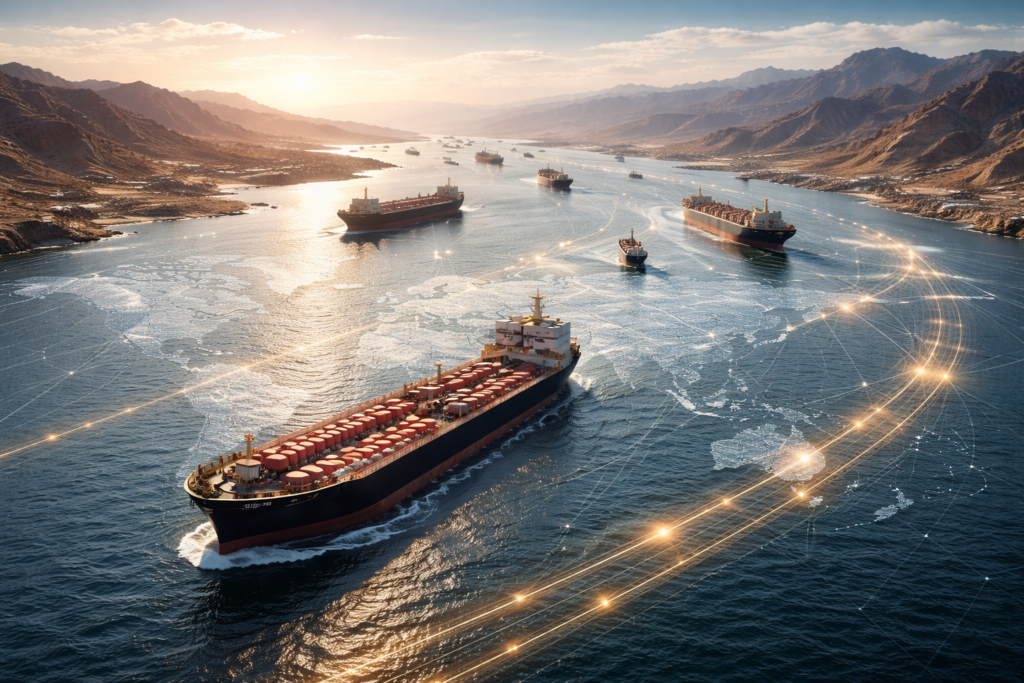
The Strait of Hormuz is a narrow sea passage connecting the Persian Gulf to the Gulf of Oman and, beyond that, the Arabian Sea. It sits between Iran to the north and the United Arab Emirates and Oman to the south.
Geographically, it’s modest in size — roughly 33 miles (53 km) across at its narrowest. But functionally, it operates as the jugular vein of the global energy system. The shipping lanes within it are only two miles wide in each direction, meaning that dozens of supertankers navigate this tight corridor daily, carrying cargo worth billions of dollars.
The countries bordering this strait — Iran, the UAE, and Oman — have enormous influence over what passes through it. And that geography-driven power has shaped decades of geopolitical tensions in the Gulf.
” If you want to know more this here : Global Crisis “
Why the Strait of Hormuz Is Important in Global Trade
To put it plainly: no other single waterway moves as much economically critical cargo as the Strait of Hormuz. Here’s why it sits at the very top of the list of global maritime trade chokepoints:
- Roughly 20–21% of the world’s total petroleum liquids pass through this strait every day — that’s approximately 20 million barrels.
- It serves as the only maritime exit for oil exports from Saudi Arabia, Iraq, Iran, Kuwait, the UAE, Qatar, and Bahrain.
- In addition to crude oil, it carries liquefied natural gas (LNG) — Qatar, one of the world’s top LNG exporters, ships nearly all of its product through Hormuz.
- It handles a substantial portion of international shipping routes connecting Asia, Europe, and the Americas with Gulf producers.
There is no realistic overland bypass for most of this cargo. A handful of pipelines exist — Saudi Arabia’s East-West Pipeline and the UAE’s Abu Dhabi Crude Oil Pipeline both terminate on the Red Sea coast — but their combined capacity covers only a fraction of what flows daily through Hormuz. For all practical purposes, if Hormuz closes, the global oil supply freezes.
Role in Global Oil and Energy Supply
The numbers alone tell a compelling story. According to the U.S. Energy Information Administration (EIA), the Strait of Hormuz is the world’s most important oil transit chokepoint by a wide margin. In 2023, daily flows through the strait were estimated at around 21 million barrels — roughly one-fifth of global consumption.
The nations most exposed to any disruption include:
- China — the world’s largest oil importer, heavily reliant on Gulf crude
- Japan and South Korea — both import the vast majority of their oil through Hormuz
- India — rapidly growing energy demand tied closely to Middle East supply
- European nations — though diversifying, many still draw from Gulf producers
LNG flows add another layer of vulnerability. Qatar’s North Field is one of the largest natural gas reserves on the planet, and nearly all of it reaches buyers in Asia and Europe by passing through the strait. A disruption wouldn’t just affect gasoline prices — it would ripple into electricity generation, industrial production, and heating costs across multiple continents.
The Strait of Hormuz importance in global trade thus extends well beyond oil. It underpins energy security for dozens of nations simultaneously, making it one of the most geopolitically sensitive pieces of real estate on the planet.
Geopolitical Significance and Risks
Here’s where things get complicated — and genuinely alarming.
Iran sits on the northern shore of the strait and has, on multiple occasions, threatened to close it in response to Western sanctions or military pressure. Iranian military doctrine explicitly treats the strait as a strategic lever: the ability to threaten closure gives Tehran a form of deterrence that no other tool quite replicates.
Key geopolitical risk factors include:
- Iran’s Revolutionary Guard (IRGC) conducting naval exercises and patrols in the strait
- Periodic seizures of commercial vessels — including the 2019 detention of the British tanker Stena Impero and multiple incidents in 2023
- U.S. military presence via the Fifth Fleet, based in Bahrain, specifically to ensure freedom of navigation
- Proxy conflicts in Yemen (Houthi attacks on Red Sea shipping) increasing broader Gulf instability
- The ever-present risk of miscalculation during periods of elevated Iran-U.S. or Iran-Israel tension
None of these risks have yet produced a full closure — and most analysts believe a prolonged shutdown is unlikely given that Iran itself exports oil through the strait. But even partial disruptions or credible threats are enough to spike oil prices globally, as markets price in uncertainty almost immediately.
This is the paradox at the heart of geopolitical tensions in the Gulf: the strait is too important for any party to permanently close, yet that very importance makes it an irresistible pressure point.
Impact of Disruptions on the Global Economy
History offers instructive examples. During the Iran-Iraq War (1980–1988), both sides attacked oil tankers in what became known as the “Tanker War,” temporarily disrupting shipping and contributing to global oil price volatility. The world economy absorbed the blow — but not without significant pain.
A major disruption today would be categorically worse, given how much deeper global supply chains have become. Consider the cascade:
- Oil prices spike within hours of a credible threat — analysts estimate a full closure could push prices to $150–$200 per barrel
- Transportation costs rise globally, affecting the price of virtually every manufactured good
- Inflation accelerates in import-dependent economies, potentially triggering central bank responses
- Industrial output slows in countries dependent on Gulf energy, from South Korean auto factories to Japanese refineries
- Currency markets destabilize in emerging economies with large energy import bills
The Strait of Hormuz importance in global trade becomes most viscerally apparent in these moments — when the abstract becomes suddenly, painfully concrete for ordinary consumers and businesses worldwide.
Recent Developments and Future Outlook
The last few years have kept the strait very much in the headlines.
In 2023 and 2024, Iran-linked forces — and in some cases the IRGC directly — seized or harassed several commercial vessels in the broader Gulf region. Simultaneously, Houthi attacks on Red Sea shipping (another critical international shipping route) raised fears of coordinated pressure on multiple chokepoints at once, forcing major shipping lines to reroute around the Cape of Good Hope at significant cost.
The Abraham Accords and broader Gulf normalization efforts have shifted some regional dynamics, with UAE and Saudi Arabia pursuing closer ties with other nations. These diplomatic movements offer a degree of stabilization, though Iran remains a significant variable.
Looking ahead, several trends will shape the strait’s future significance:
- Energy transition: As renewable energy scales globally, long-term demand for Gulf oil may plateau — but this is a decades-long process, and Hormuz will remain critical well through the 2030s
- Asian demand growth: China and India’s continued industrialization keeps Gulf crude indispensable for the foreseeable future
- Infrastructure investment: The UAE’s expanded pipeline capacity and Saudi Arabia’s Vision 2030 infrastructure buildout may modestly reduce Hormuz dependency over time
- Geopolitical realignment: The evolving U.S.-China-Iran triangle will continue defining the risk calculus around the strait
In short: the Strait of Hormuz importance in global trade isn’t fading anytime soon. If anything, as global competition for energy resources intensifies, its strategic value only grows.
Conclusion
Thirty-three miles of water. One-fifth of the world’s oil. Dozens of nations holding their breath every time tensions flare in the Gulf.
The Strait of Hormuz importance in global trade is not a niche concern for geopolitical analysts — it is, in the most literal sense, everyone’s concern. Whether you’re a policymaker in Washington, a factory owner in Seoul, or a driver filling up in London, the conditions in this narrow waterway shape your economic reality in ways both visible and invisible.
As the global economy continues wrestling with energy security, supply chain resilience, and the long transition toward cleaner fuels, the strait will remain one of the defining pressure points of the 21st century. Keeping it open, stable, and navigable isn’t just a regional interest — it’s a global imperative.
2 thoughts on “Strait of Hormuz Importance in Global Trade”