
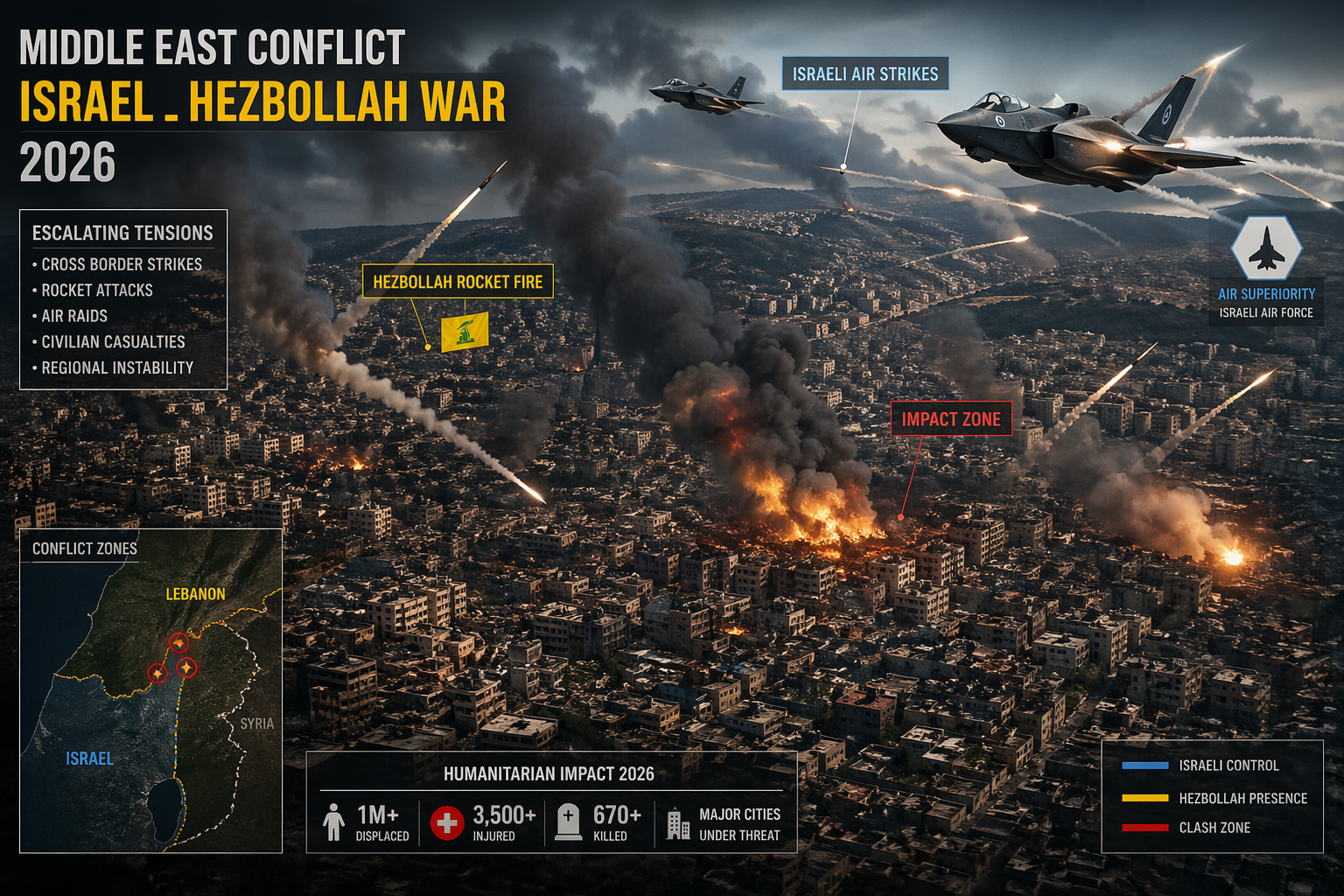
The Middle East is burning again. Since March 2026, the Israel–Hezbollah war has killed over 2,000 people, displaced more than a million Lebanese civilians, and pushed an already broken Lebanon to the absolute edge of collapse. This is the most comprehensive breakdown you’ll find — from how the war started, to what’s happening on the ground right now, to whether this conflict could ignite a region-wide inferno.
Deaths in Lebanon (2026)
People Displaced
Killed in Single Day (Apr 8)
🔥 How the Israel–Hezbollah War 2026 Actually Began
To understand the Israel Hezbollah war 2026, you have to go back further than March. This isn’t a war that simply “started” — it’s a conflict that has been simmering since October 2023, when Hezbollah launched strikes against Israel in solidarity with Palestinians following the Hamas attacks on 7 October. For more than a year, a low-level exchange of fire ground on along the Israel–Lebanon border, claiming lives on both sides and displacing communities in northern Israel and southern Lebanon.
In October 2024, Israel launched an invasion of southern Lebanon that ended in a fragile US-brokered ceasefire in November — but not before Israeli forces assassinated Hezbollah’s longtime leader, Hassan Nasrallah. The ceasefire, however, never truly held. Israeli airstrikes continued into Lebanon almost every day through 2025, killing hundreds more. Simultaneously, Hezbollah violated ceasefire terms by quietly rebuilding its military infrastructure and weapons arsenal. The truce was a pause, not a peace.
Then came February 28, 2026 — the spark that detonated everything. Israel and the United States launched a joint military campaign against Iran, Hezbollah’s primary backer, and in those strikes, Iranian Supreme Leader Ali Khamenei was killed. The shock reverberated across the entire region. Within 48 hours, Hezbollah’s new secretary-general Naim Qassem vowed retaliation. On 2 March 2026, Hezbollah fired projectiles into northern Israel for the first time since the 2024 ceasefire — and the full-scale Israel Lebanon conflict 2026 was underway.
Key Timeline: Israel Hezbollah Conflict 2026
Hezbollah opens a “support front” for Gaza, exchanging daily fire with Israel along the Lebanon border.
Israel invades southern Lebanon. Hassan Nasrallah is killed. A US-brokered ceasefire is signed — but barely respected.
US-Israeli joint strikes target Iran. Khamenei is killed. The Middle East enters a new phase.
Hezbollah resumes rocket fire into northern Israel. Full-scale war erupts. Israel launches massive airstrikes across Lebanon.
Israeli ground forces enter southern Lebanon, deploying five divisions. The battle for Bint Jbeil begins.
Israel announces plans to demolish Lebanese border settlements and occupy southern Lebanon up to the Litani River as a “security zone.”
Israel launches Operation Eternal Darkness — its largest assault of the war — killing at least 357 people in a single day. Lebanon calls it “Black Wednesday.”
Historic Israel-Lebanon ceasefire talks announced. Israel continues strikes. Diplomatic pressure intensifies from the US, EU, UN, and Arab states.
💣 Operation Eternal Darkness: The War’s Bloodiest Day
On April 8, 2026, Israel unleashed what it called its most powerful assault of the entire Israel Lebanon war 2026. Dubbed Operation Eternal Darkness, the campaign involved fifty Israeli Air Force fighter jets and approximately 160 munitions, striking over 100 Hezbollah-linked targets across the country in under ten minutes. The death toll from that single day: at least 357 people.
The strikes hit central Beirut, southern Lebanon, the port city of Sidon, the Beqaa Valley, and the city of Tyre — without prior warning in many areas. Witnesses reported charred bodies at Beirut’s busiest intersections. Lebanon’s government declared a national day of mourning and called the assault a massacre. The Lebanese President described it in one word: catastrophe.
“This is a residential area. There is nothing military here.”
— Beirut municipality official, April 8, 2026 (Al Jazeera)
Over twenty countries condemned the strikes. The EU and UK called for Lebanon to be included in the Iran ceasefire. The United Nations emergency relief chief labeled the Middle East war’s cost a staggering billion dollars a day. And yet, Israel rejected ceasefire demands related to Lebanon and confirmed it would continue operations until Hezbollah was disarmed and dismantled from southern Lebanon.
For deeper context on how the Strait of Hormuz plays into the region’s economic pressure, read our in-depth report: Strait of Hormuz Latest News Today (2026 Update).
🇱🇧 Why Lebanon Is on the Brink of Total Collapse in 2026
For many countries, war is a crisis. For Lebanon, the Israel Hezbollah 2026 war is a final blow to a nation that was already barely standing. Lebanon has been in a state of cascading collapse since 2019, and understanding that context is essential to understanding why this conflict is so catastrophic.
Lebanon’s Economic Collapse: The Foundation Was Already Broken
The Lebanese lira had already lost over 98% of its value between 2023 and early 2024. Hyperinflation wiped out the savings of ordinary families overnight. Today, approximately 80% of Lebanon’s population lives in poverty, lacking reliable access to healthcare, electricity, and education. The banking system effectively stole from its own depositors — billions were transferred abroad by the politically connected while ordinary citizens found their life savings locked behind bank doors that, in April 2026, remain shut.
Unemployment among Lebanese nationals stood at 27% in the months before the latest escalation. The country’s public debt was already among the highest in the world relative to GDP. The state couldn’t keep the lights on, couldn’t pay government salaries reliably, and couldn’t rebuild after the catastrophic 2020 Beirut port explosion that killed over 200 people and caused billions in damage. And then the bombs started falling again.
The Human Cost: Over a Million Displaced
More than 1 million people have been displaced in Lebanon since 2 March 2026 — roughly 20% of the entire country’s population. Over 600 collective shelters are nearly 94% full. Children are sleeping in schools, families are living in cars, and the government has no functioning safety net left to offer. The IRC placed Lebanon on its 2026 Emergency Watchlist before the war even escalated, flagging it as one of the countries most likely to experience a deteriorating humanitarian crisis.
The UN and its partners launched a humanitarian appeal for $308.3 million just to cover emergency needs for March to May 2026. An estimated 961,000 people now face acute food insecurity. Children represent approximately 20% of fatalities in the conflict — a horrifying statistic that reveals the indiscriminate nature of the destruction.
“All of this together is frankly a perfect storm of unpredictable challenges.”
— Imran Riza, UN Humanitarian Coordinator in Lebanon, March 2026
Lebanon is now on the verge of becoming a functionally failed state — sustained by international aid rather than a functioning economy. If the conflict continues and international funding dries up, analysts warn poverty could reach 90%+ of the population.
For broader context on the political and economic forces reshaping the world right now, see our analysis: Biggest Political & Economic Trends Happening Right Now in 2026.

🌍 Could the Israel–Hezbollah War Spread Across the Entire Middle East?
This is the question keeping diplomats, intelligence agencies, and world leaders awake at night. The Israel Hezbollah war 2026 is not happening in isolation — it is one thread in a deeply tangled regional knot that involves Iran, the United States, Iraq, Yemen, Syria, and beyond.
Iran’s Role: The Key Variable
Iran has been the central force in this escalation. The killing of Khamenei in the February US-Israeli strikes fundamentally destabilized the regional power structure. Iran’s new leadership has used Lebanon as leverage in its ceasefire negotiations with the US, essentially saying: there can be no deal with Washington unless the war on Hezbollah stops too. Iran also responded to Israeli strikes by continuing to keep the Strait of Hormuz partially shut — a move that sends shockwaves through global oil markets and food supply chains.
Read our dedicated deep-dive into what’s at stake: Strait of Hormuz Importance in Global Trade.
The US Ceasefire Dilemma
The United States has found itself in a diplomatically awkward position. President Trump struck a two-week ceasefire with Iran — but the question of whether Lebanon was included in that deal became a major source of confusion and controversy. Iran and mediator Pakistan insisted Lebanon was part of the agreement. Israel flatly rejected that interpretation and continued its military campaign. Trump sided with Netanyahu, contradicting earlier US diplomatic signals.
This incoherence has damaged US credibility in the region and emboldened hardliners on multiple sides. For the full story on the Iran-US ceasefire and what it means, see: Iran–US Ceasefire for Two Weeks: A Critical Moment for Global Tensions.
Proxy Wars and the Regional Domino Effect
The risk of broader Middle East escalation in 2026 is real and multi-dimensional. Several factors could trigger a wider war:
1. Hezbollah’s Rocket Depth: Hezbollah fired over 1,000 attack waves against Israel since the March escalation began. On its most intense single day, it launched 105 separate attack waves. This is not a militarily exhausted organization — it is hurt, but it still possesses the capacity to hit deep into Israel.
2. The Houthi Factor: Yemen’s Houthi movement, another Iranian-backed group, remains a wildcard. Any further escalation involving Iran could trigger renewed Houthi strikes on shipping lanes and Gulf infrastructure.
3. Syrian Spillover: Southern Syria remains a zone of Israeli military activity, with Israeli strikes targeting weapons transfers and Iranian-linked infrastructure. An accidental or deliberate strike that kills Syrian forces could drag Damascus — however reluctantly — into the confrontation.
4. Gulf Arab Paralysis: The Gulf states that provided critical humanitarian and diplomatic support to Lebanon during the 2024 escalation are now preoccupied with their own security concerns following the Iran war. Saudi Arabia, UAE, Qatar — all are navigating their own exposure to a conflict that could hit their oil facilities and financial stability.
“The toll on civilians is huge. They should not be the ones paying the price.”
— Imran Riza, UN Humanitarian Coordinator, Lebanon, March 2026
What the Ceasefire Talks Mean
On April 10, 2026, Israel and Lebanon announced what mediators called “historic” ceasefire talks scheduled for Washington. Israeli Prime Minister Netanyahu framed them as an opportunity to push for Hezbollah’s complete disarmament and potentially a formal peace agreement — the first between the two countries. Lebanese President Joseph Aoun welcomed the dialogue, though he and his government made clear that the killing must stop first. Israel, however, continued launching strikes even after the talks were announced.
As of April 22, 2026, the situation remains deeply volatile. The Israel Hezbollah ceasefire remains elusive. The Washington talks are the most promising diplomatic development in weeks — but with over 2,000 Lebanese dead, a million displaced, and a country in economic freefall, the distance between talking and peace remains enormous.
📊 The Global Impact: Why This War Matters Beyond the Region
Even for readers far from the Middle East, the Israel Lebanon war 2026 has direct, measurable consequences that touch everyday life. Here’s why the world is watching:
Energy Prices: The Strait of Hormuz — through which roughly 21 million barrels of oil pass daily — has been impacted by Iran’s war posture. Any further closure or major escalation sends energy prices surging globally. Families from Pakistan to Poland pay more to heat their homes and fill their tanks.
Food Security: The IRC has warned of a growing food crisis driven by the effective closure of the Strait of Hormuz, which facilitates approximately 30% of global fertilizer trade. Critical planting decisions across East Africa and South Asia must be made within weeks. Delays now translate to rising hunger by June 2026.
Refugee Flows: Lebanon already hosts one of the world’s largest refugee populations per capita — roughly one in five people in the country is a refugee. A complete state collapse would trigger one of the largest refugee crises Europe has seen since 2015.
Global Political Instability: The war is reshaping alliances, testing the US-Iran diplomatic channel, straining NATO solidarity, and exposing the limits of international law when powerful states act with impunity. For a broader view of how global political and economic trends are intersecting, read our report: Biggest Political & Economic Trends Happening Right Now.
🔗 What Global Experts & Organizations Are Saying
The international response to the Israel Hezbollah conflict 2026 has been loud — though not always effective. Here’s where major institutions stand:
The United Nations Office for the Coordination of Humanitarian Affairs (OCHA) has called the situation in Lebanon “the most serious deterioration in security conditions since the November 2024 ceasefire” and has appealed for hundreds of millions in emergency funding.
The International Rescue Committee (IRC) placed Lebanon on its 2026 Emergency Watchlist and has called for an immediate ceasefire, with IRC President David Miliband personally visiting Lebanon’s humanitarian response operations.
Al Jazeera’s ongoing coverage of ceasefire dynamics provides real-time updates on the diplomatic track, including Israel’s stated position that it will not negotiate a ceasefire with Hezbollah before the Washington talks.
The UN News describes Lebanon as facing “a perfect storm” — a phrase that captures what happens when war, economic collapse, displacement, and funding shortfalls hit simultaneously.
🎯 Final Verdict: What Happens Next in the Israel Hezbollah War?
The Israel vs Hezbollah war 2026 has already changed the Middle East — permanently. Hezbollah has been degraded but not destroyed. Lebanon has been devastated but not defeated. Israel has achieved significant military objectives but faces growing diplomatic isolation. The United States has a ceasefire with Iran that is fragile and contested. And the people of Lebanon — who never chose this war — are paying the highest price.
Three scenarios are now possible. First: the Washington ceasefire talks produce a genuine deal, Hezbollah disarms from southern Lebanon, and reconstruction begins under international supervision. Second: talks collapse, Israel continues its occupation of the Litani zone, Lebanon descends into failed-state status, and the conflict becomes frozen. Third: Iran’s nuclear program or another provocation triggers a new escalation, pulling the entire region into a wider war that no one — not even the governments ordering the strikes — can fully control.
The world is at a pivot point. Every reader, every voter, every citizen has a stake in what happens next. Stay informed — and keep watching.
❓ Frequently Asked Questions
When did the Israel Hezbollah war 2026 officially start?
The current round of full-scale fighting officially resumed on 2 March 2026, when Hezbollah launched projectiles into northern Israel following the US-Israeli joint strikes on Iran on February 28. However, the conflict’s roots stretch back to October 2023 when Hezbollah opened a “support front” for Gaza.
How many people have been killed and displaced in Lebanon in 2026?
As of late April 2026, the conflict has killed over 2,055 people in Lebanon, including at least 165 children. More than 1 million people have been displaced — approximately 20% of Lebanon’s entire population — with over 600 collective shelters nearly at full capacity.
What is Operation Eternal Darkness?
Operation Eternal Darkness was the Israeli military’s codename for its massive airstrike campaign launched on April 8, 2026. It involved 50 fighter jets, approximately 160 munitions, and struck over 100 targets across Lebanon — including central Beirut — in under ten minutes. At least 357 people were killed, making it the deadliest single day of the war.
Is a ceasefire between Israel and Lebanon possible?
Ceasefire talks between Israel and Lebanon were announced on April 10, 2026 and described as “historic.” However, Israel has stated it will not negotiate a ceasefire with Hezbollah directly, and continued military operations even after talks were announced. The situation as of April 22 remains fragile and deeply uncertain.
Why is Lebanon collapsing in 2026?
Lebanon’s collapse is the result of multiple compounding crises: a catastrophic economic collapse since 2019, the Lebanese lira losing over 98% of its value, roughly 80% of the population now living in poverty, the devastating 2020 Beirut port explosion, chronic political dysfunction — and now the 2026 military escalation that has displaced over a million people and destroyed critical infrastructure.
Could the Israel Hezbollah war spread to a wider Middle East conflict?
The risk of wider regional escalation is real. Key factors include Hezbollah’s continued rocket capability, Iran’s leverage over ceasefire talks, potential Houthi reactivation, Syrian spillover risks, and the fragility of the US-Iran ceasefire. The Strait of Hormuz situation and food supply disruptions show how far the conflict’s consequences already reach beyond Lebanon and Israel.
What role does Iran play in the Israel Hezbollah war 2026?
Iran is Hezbollah’s primary backer — financially, militarily, and ideologically. The killing of Iranian Supreme Leader Khamenei in the February 2026 US-Israeli strikes directly triggered Hezbollah’s resumption of hostilities. Iran has also tied Lebanon’s fate to its own ceasefire negotiations with the US, making the two conflicts diplomatically inseparable.