
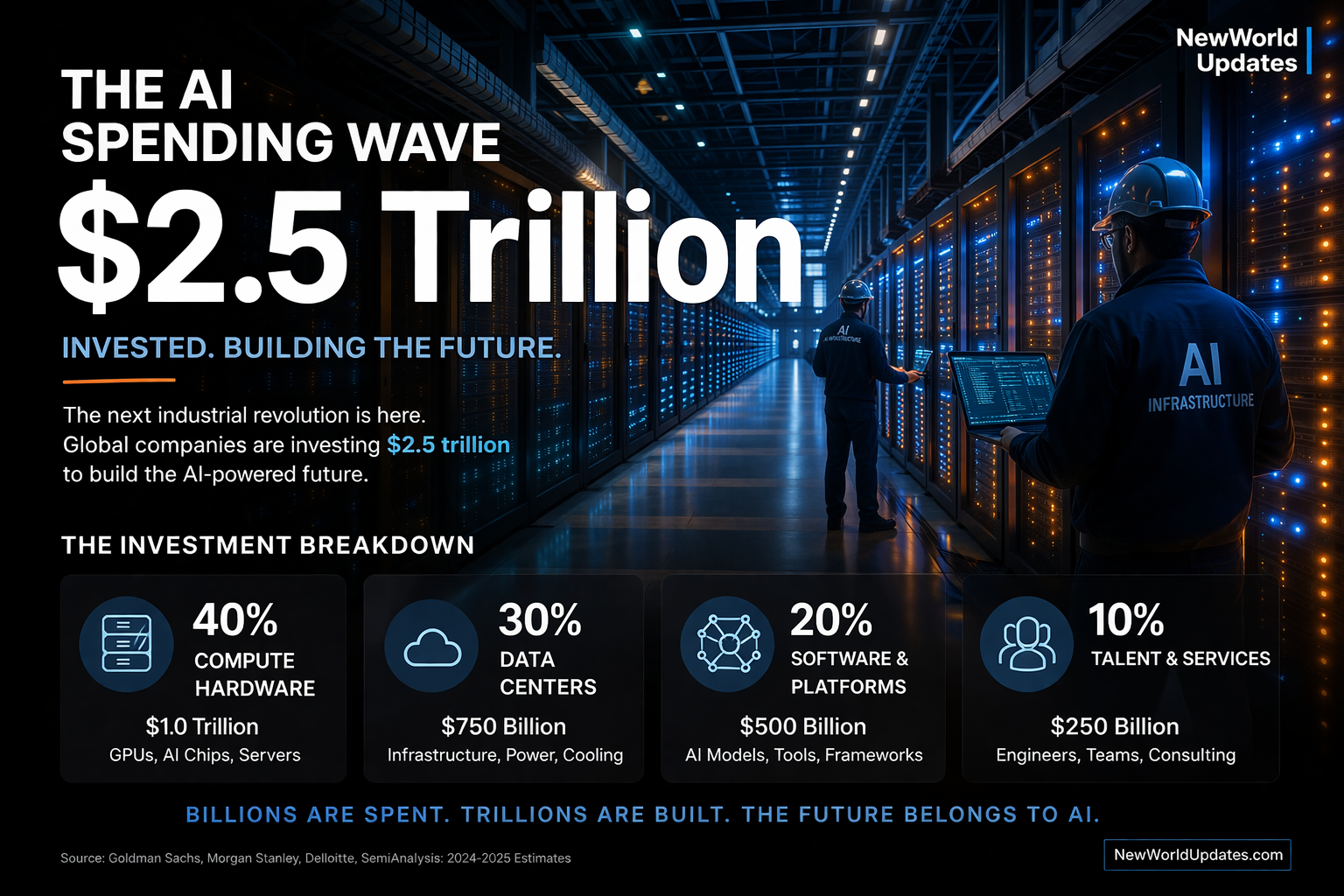
The biggest capital wave in tech history is crashing across every sector simultaneously — and the winners and losers are not who you’d expect.
NewWorldUpdates Staff · April 3, 2026 · 9 min read · Innovation · AI
If you want to know more about Innovation-AI here is AGENTIC AI: THE RISE OF AUTONOMOUS DIGITAL WORKERS IN 2026
A Once-in-a-Generation Shift
Every decade or so, a technology emerges that forces entire industries to reorganize around it — or risk being left behind.
The internet was one.
The smartphone was another.
AI in 2026 is something entirely different.
It is the first technology being adopted at internet scale, smartphone speed, and industrial cost — all at once.
The Number That Changes Everything

Here is the number that stops conversations cold:
$2.5 trillion
That is the total global spending on AI in 2026, according to Gartner — a 44% increase over 2025, making it the largest single-year capital surge in technology history.
To put it into perspective: even the dot-com boom of the late 1990s looks modest by comparison.
This is not hype.
This is real capital deployment:
- Data centers being built
- Chips being manufactured
- Models being trained and deployed
- Entire businesses being rewired from the inside out
The debate is over. AI will transform every industry.
The only question now is:
Who captures the upside — and who absorbs the disruption?
Where the Money Is Actually Going
When people hear “$2.5 trillion,” they imagine robots and science fiction.
The reality is both more grounded — and more important.
Most of this capital is flowing into the physical backbone of AI:
- Data centers
- GPUs and chips
- Servers
- Power and cooling infrastructure
Big Tech Spending Surge (2026)
- Amazon: $200 billion in AI infrastructure
- Google: $185 billion
- Meta: up to $135 billion
- Microsoft: approximately $145 billion
Together, these four companies are investing $665 billion in a single year — a 74% increase from 2025.
The NVIDIA Effect
At the center of it all is NVIDIA:
- 92% share of the data center GPU market
- $62.3 billion in quarterly data center revenue
- 75% year-over-year growth
- Chip supply sold out 18–24 months in advance
The constraint is no longer ambition.
It is physical capacity:
- Chips
- Electricity
- Cooling systems
The Hidden Shift: From Training to Inference
The most important change in AI right now is largely invisible.
For years, the focus was on training massive AI models.
That phase is maturing.
Now, inference — the actual use of AI — dominates.
- 60–70% of AI compute demand now comes from inference
- Up from ~40% in 2024
Every AI interaction you see:
- Search summaries
- Chatbots
- AI agents
That is inference — running at billions of requests per day.
What This Changes
Winning in AI is no longer just about building the best model.
It is about:
- Delivering it at scale
- Keeping costs low
- Ensuring speed and reliability
This is why:
- Google Cloud revenue jumped 48% YoY
- Enterprises are shifting from experimentation to real deployment
AI is no longer theoretical.
It is operational.
Who Wins — and Who Pays the Price
The $2.5 trillion boom is not lifting everyone equally.
Winners
- Chip manufacturers (demand exceeds supply)
- Cloud providers (AWS, Google Cloud, Azure)
- AI-skilled workers (1.5× more likely to be promoted)
- Infrastructure specialists (electricians, HVAC engineers)
- AI-native companies replacing legacy systems
- Investors backing real AI adoption
Under Pressure
- Entry-level knowledge workers
- Early-stage startups (funding tightening)
- “AI-washing” companies without real deployment
- Mid-market software providers
- Regions with strained power grids
- Organizations slow to reskill their workforce
The Workforce Reality
The labor impact is complex — and accelerating.
- AI job-loss anxiety: 28% (2024) → 40% (2026)
- Estimated displacement: 6–7% of workers
- Productivity upside: +15%
But the real divide is clear:
It is not humans vs machines.
It is humans using AI vs humans not using AI.
- 89% promotion rate for AI-trained workers
- vs 53% for others
Case Study: Meta’s AI-Native Shift
In April 2026, Meta announced layoffs affecting ~15,000 employees (20% workforce).
Not due to losses.
But due to efficiency.
AI agents like:
- DevMate
- MetaMate
…can now handle up to 70% of routine tasks.
Wall Street responded positively.
The message is unmistakable:
If one of the most advanced tech companies in the world is replacing engineers with AI — no white-collar job is immune.
The “Trough of Disillusionment” — Misunderstood
Gartner now places AI in the Trough of Disillusionment.
That sounds negative.
It is not.
It means:
- Easy wins are over
- Real ROI is now required
- Execution matters more than hype
Funding is tightening. Expectations are rising.
But here is the key difference from past tech cycles:
Spending is not slowing down.
- AI infrastructure demand is still accelerating
- Cloud revenues are growing 40–50% annually
- 80% of projected AI investment through 2028 is still ahead
Final Insight: This Is Happening Now
The $2.5 trillion AI wave is not a prediction.
It is a live capital event.
Happening now.
At global scale.
The real question is not:
“Will AI impact my industry?”
It is:
“What am I doing about it this quarter?”
Because by the time you react,
the competitive gap may already be irreversible.
Join the Conversation
What industry are you in — and how is AI already affecting your daily work?
Drop your thoughts in the comments.
If this article sharpened your perspective, share it with someone who needs to see it.