
Introduction
Every year on the last Monday of May, something shifts across America. Flags drop to half-staff before sunrise. Families load into cars heading toward cemeteries with flowers in hand. Somewhere on a town’s main street, a parade forms — veterans in uniform, school bands, fire trucks — while onlookers press their hands to their hearts.
Memorial Day is one of those rare national observances that still carries genuine weight. It isn’t a holiday in the usual sense. It’s a reckoning — a collective pause to remember the men and women who went to war and never came back.
In 2026, that pause carries even more meaning. Memorial Day 2026 falls on Monday, May 25, and it arrives at a uniquely historic moment: the United States is marking its 250th year of independence. This year’s observances are tied to the Freedom 250 initiative, a nationwide celebration linking military sacrifice directly to the founding ideals of the republic. From Washington, D.C. to small towns across all 50 states, this is shaping up to be a Memorial Day unlike any in living memory.
This guide covers everything worth knowing — the date, the deep history, the difference between Memorial Day and Veterans Day, the national events happening in 2026, and practical ways you can observe the day with genuine intention.
Table of Contents
- When Is Memorial Day 2026?
- What Memorial Day Actually Means
- The Origins of Memorial Day: A History Worth Knowing
- Memorial Day vs. Veterans Day — What’s the Difference?
- Memorial Day 2026 and America’s 250th Anniversary
- Major National Events and Ceremonies for Memorial Day 2026
- Meaningful Ways to Observe Memorial Day 2026
- Memorial Day Traditions Across America
- What Businesses, Schools, and Government Offices Do on Memorial Day
- FAQs About Memorial Day 2026
When Is Memorial Day 2026?
Memorial Day 2026 is on Monday, May 25, 2026.
The holiday is always observed on the last Monday of May, a schedule that has been fixed since the Uniform Monday Holiday Act of 1968 took effect in 1971. That legislation was designed to create consistent three-day weekends for federal employees — though the holiday itself predates that law by more than a century.
Memorial Day weekend 2026 runs from Saturday, May 23 through Monday, May 25. For most Americans, this means a long weekend, but the day itself is a federal holiday with specific traditions, ceremonies, and national significance attached to it.
What Memorial Day Actually Means
Here’s something worth saying plainly: Memorial Day is not about celebrating military service in general. It is specifically and exclusively dedicated to honoring U.S. military personnel who died while serving in the armed forces.
That distinction matters. Memorial Day commemorates the fallen — soldiers, sailors, airmen, and marines who gave their lives in service to the country. It is a day of mourning as much as a day of pride.
The holiday has, over time, become culturally associated with the unofficial start of summer — backyard barbecues, beach trips, retail sales. None of that is wrong, exactly. But the core purpose of the day remains remembrance, and most Americans who have lost someone in uniform never lose sight of that.
The Origins of Memorial Day: A History Worth Knowing
Decoration Day and the Civil War
The roots of Memorial Day stretch back to the years immediately following the Civil War — a conflict that claimed roughly 620,000 American lives and left communities shattered on both sides of the Mason-Dixon line. In the grief-soaked aftermath, people naturally began visiting the graves of soldiers, laying flowers, and marking the loss in whatever ways felt right.
The formal beginning of what we now call Memorial Day is traced to May 30, 1868, when Major General John A. Logan — leader of the Grand Army of the Republic, a Union veterans’ organization — issued a proclamation calling for a nationwide day of remembrance. He called it Decoration Day, a name drawn from the act of decorating soldiers’ graves with flowers, flags, and other tributes.
The date of May 30 was deliberately chosen because it wasn’t the anniversary of any particular battle. It also fell late enough in spring that flowers would be available across most of the country — a small but thoughtful detail.
The first large-scale observance took place at Arlington National Cemetery, where flowers were placed on the graves of both Union and Confederate soldiers. That act of cross-party grieving said something significant about what the day was meant to represent.
From Decoration Day to a Federal Holiday
For decades, the holiday was observed inconsistently — some states recognized May 30, others held observances on different dates, and the Southern states resisted the Union-origin story of the holiday for years, holding their own Confederate memorial days instead.
After World War I, the day expanded in spirit. It was no longer just about Civil War soldiers. It became a day to honor Americans who had died in any war. By the time World War II ended and millions of veterans returned home — or didn’t — Decoration Day had evolved into something closer to what we recognize today.
It wasn’t until 1971, under the Uniform Monday Holiday Act, that Memorial Day became an official federal holiday, moved permanently to the last Monday of May.
Memorial Day vs. Veterans Day — What’s the Difference?
This is one of the most common points of confusion around American military observances, and it’s worth clarifying.
- Memorial Day honors U.S. military personnel who died in service to the country.
- Veterans Day (November 11) honors all who have served in the U.S. military, living and deceased.
- Armed Forces Day (the third Saturday in May) recognizes those currently serving.
Each holiday has its own distinct purpose. On Memorial Day, the focus is grief, remembrance, and gratitude for the ultimate sacrifice. It is not a day to thank a veteran for their service — it is a day to mourn those who never came home.
Memorial Day 2026 and America’s 250th Anniversary
This year’s Memorial Day lands at a genuinely historic juncture. The United States is marking its 250th anniversary of independence in 2026, and Memorial Day has become the symbolic opening chapter of that summer-long national celebration.
The Freedom 250 initiative — a partnership between the American Veterans Center, federal agencies, and local governments across the country — has positioned Memorial Day 2026 as the official launch of America’s semiquincentennial summer. The message is straightforward: the nation’s 250 years of freedom were purchased through military sacrifice, and this year’s Memorial Day honors both the holiday’s original purpose and the country’s founding ideals.
That framing gives 2026’s observances a weight and scale that goes beyond any typical Memorial Day in recent decades.
Major National Events and Ceremonies for Memorial Day 2026
The Freedom 250 National Memorial Day Parade
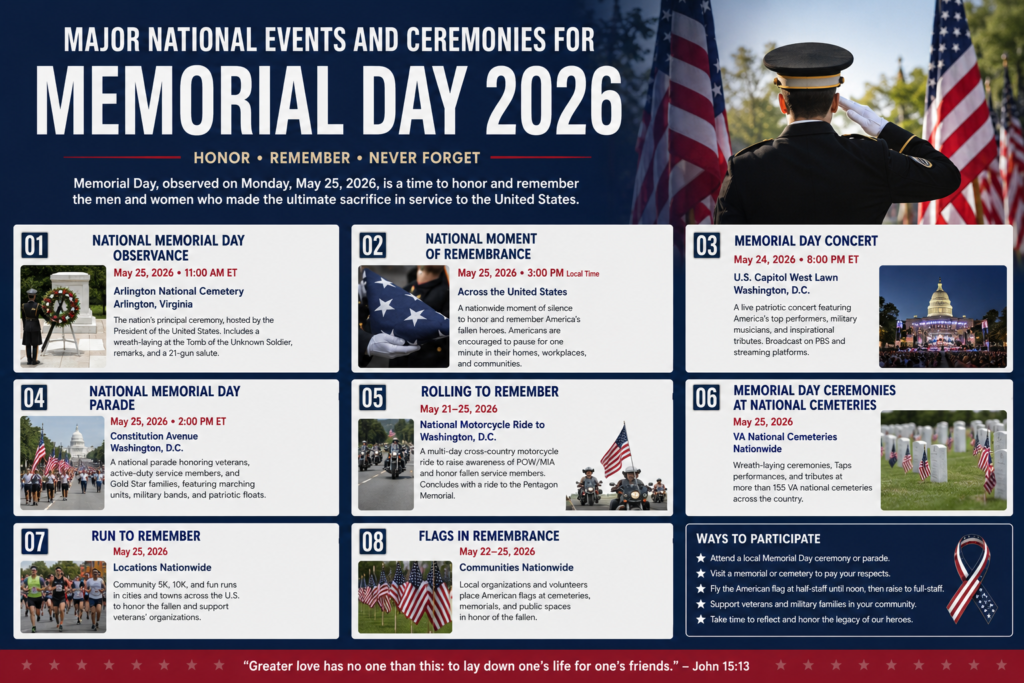
The centerpiece of Washington, D.C.’s Memorial Day observances is the Freedom 250 National Memorial Day Parade, held Monday, May 25 along Constitution Avenue NW. The parade route runs from 7th Street to 17th Street NW, presented in partnership with Boeing and organized by the American Veterans Center. Musical performances begin at 9:00 a.m. ET near the National Archives, with the parade stepping off at 10:00 a.m. ET. The event is free and open to the public.
Arlington National Cemetery Observances
Arlington National Cemetery is, as always, the emotional heart of Memorial Day. This year, observances include two significant events:
Daytime Ceremony: The Memorial Day Observance at Arlington features tributes to Gold Star Families and Wounded Heroes, performances by military bands, and country music artist and U.S. Army veteran Craig Morgan. The ceremony is open to the public on a first-come, first-served basis.
Evening Candlelight Event: The day concludes with the Freedom 250 National Memorial Day Observance: An Evening of Stories and Service at the Memorial Amphitheater. Doors open at 6:00 p.m. ET, with the program beginning at 8:30 p.m. ET. Lit by candlelight, veterans, military families, and historians share personal stories of service and sacrifice. Grammy Award-winning country artist Gretchen Wilson performs musical tributes throughout the evening. This is a ticketed event held as part of America’s 250th anniversary observance.
Rolling to Remember
Kicking off the weekend, Rolling to Remember is a massive motorcycle ride organized by veterans’ groups to honor prisoners of war and those missing in action. The ride draws thousands of participants into Washington, D.C. and has become one of the defining traditions of Memorial Day weekend.
National Memorial Day Concert
The National Memorial Day Concert is held on the West Lawn of the U.S. Capitol and broadcast nationally on PBS. It has been a fixture of the holiday for decades, blending musical performances with tributes to veterans, military families, and the stories of fallen service members.
VA National Cemetery Observances
The U.S. Department of Veterans Affairs hosts Memorial Day ceremonies at national cemeteries across the country — from Arlington in Virginia to the Florida National Cemetery, Bay Pines, Barrancas, and dozens of others. Volunteers place American flags at veterans’ graves in the days leading up to the holiday, creating the iconic sight of thousands of small flags standing in perfect rows across rolling green lawns.
For a full list of VA-hosted observances, visit va.gov.
Meaningful Ways to Observe Memorial Day 2026
Memorial Day doesn’t require a trip to Washington, D.C. to be meaningful. Some of the most powerful observances happen in backyards, at local cemeteries, and around kitchen tables.
Attend a local ceremony or parade. Virtually every American city and most towns hold a Memorial Day ceremony. Check with your local veterans organizations, American Legion posts, or city hall for events near you.
Visit a cemetery. Bring flowers or a small flag. You don’t need to know the people buried there — the act of showing up matters.
Observe the National Moment of Remembrance. At 3:00 p.m. local time on Memorial Day, Americans are encouraged to pause for one minute of silence in honor of the fallen. It’s a simple act, but a powerful one.
Fly the flag correctly. The American flag should be flown at half-staff from sunrise until noon, then raised to full-staff from noon until sunset on Memorial Day.
Talk to your family about what the day means. For younger generations who haven’t experienced military loss, Memorial Day can feel abstract. Sharing stories — or simply explaining who the day is for — matters.
Support Gold Star families. Organizations like the Gold Star Families Memorial Foundation support those who have lost a loved one in military service. A donation or volunteer hour goes further than most people realize.
Educate yourself on military history. Reading about conflicts like World War II, Korea, Vietnam, Iraq, or Afghanistan — and the human cost they carried — is itself a form of remembrance.
Memorial Day Traditions Across America
The way Americans observe Memorial Day varies widely by region, community, and family history. But several traditions show up consistently across the country.
- Flag placement at military cemeteries: In the days before Memorial Day, volunteers and active-duty service members place small American flags at every grave in national cemeteries. At Arlington alone, that means placing flags at more than 260,000 headstones.
- Wreath-laying ceremonies: Political leaders and military officials lay wreaths at the Tomb of the Unknown Soldier at Arlington and at war memorials across the country.
- Parades: From the enormous national parade in Washington, D.C. to small-town processions led by local veterans, parades remain one of the most visible Memorial Day traditions.
- Concerts and musical tributes: The National Memorial Day Concert and local events blend patriotic music with stories of sacrifice and service.
- Community cookouts and gatherings: The cultural association of Memorial Day with the beginning of summer is longstanding. Family gatherings, cookouts, and outdoor activities are part of how millions of Americans mark the day — often alongside more formal observances.
What Businesses, Schools, and Government Offices Do on Memorial Day
As a federal holiday, government offices, courts, banks, and post offices are closed on Memorial Day. Schools are also closed in most jurisdictions, making the long weekend a de facto family holiday.
Many private businesses choose to remain open, though a large number — particularly retailers — run Memorial Day sales. The holiday has become one of the biggest sales weekends of the year in American retail, a fact that sits in some tension with the day’s solemn purpose but reflects the dual nature of how Americans have come to experience it.
Conclusion
Memorial Day 2026 is not just another federal holiday on the calendar. It arrives at a moment when the country is pausing — not just to mark 250 years of independence, but to reckon with what that independence actually cost. Every flag in every row at every national cemetery is a life. Every parade is a community choosing to remember rather than forget.
The barbecues and beach trips aren’t the problem. Americans have always found ways to hold both the grief and the gratitude at the same time. What matters is that somewhere in the weekend, there’s a moment — at 3:00 p.m. or at a ceremony or even just in a quiet kitchen — when someone stops and thinks about the people this day was built for.
That’s what Memorial Day has always asked of us. In 2026, with the country marking 250 years, that ask feels more worth honoring than ever.