
🔴 Breaking — Updated April 27, 2026
✍️ DailyUpdates360 Team📅 April 27, 2026⏱ 16 min read🌍 World News
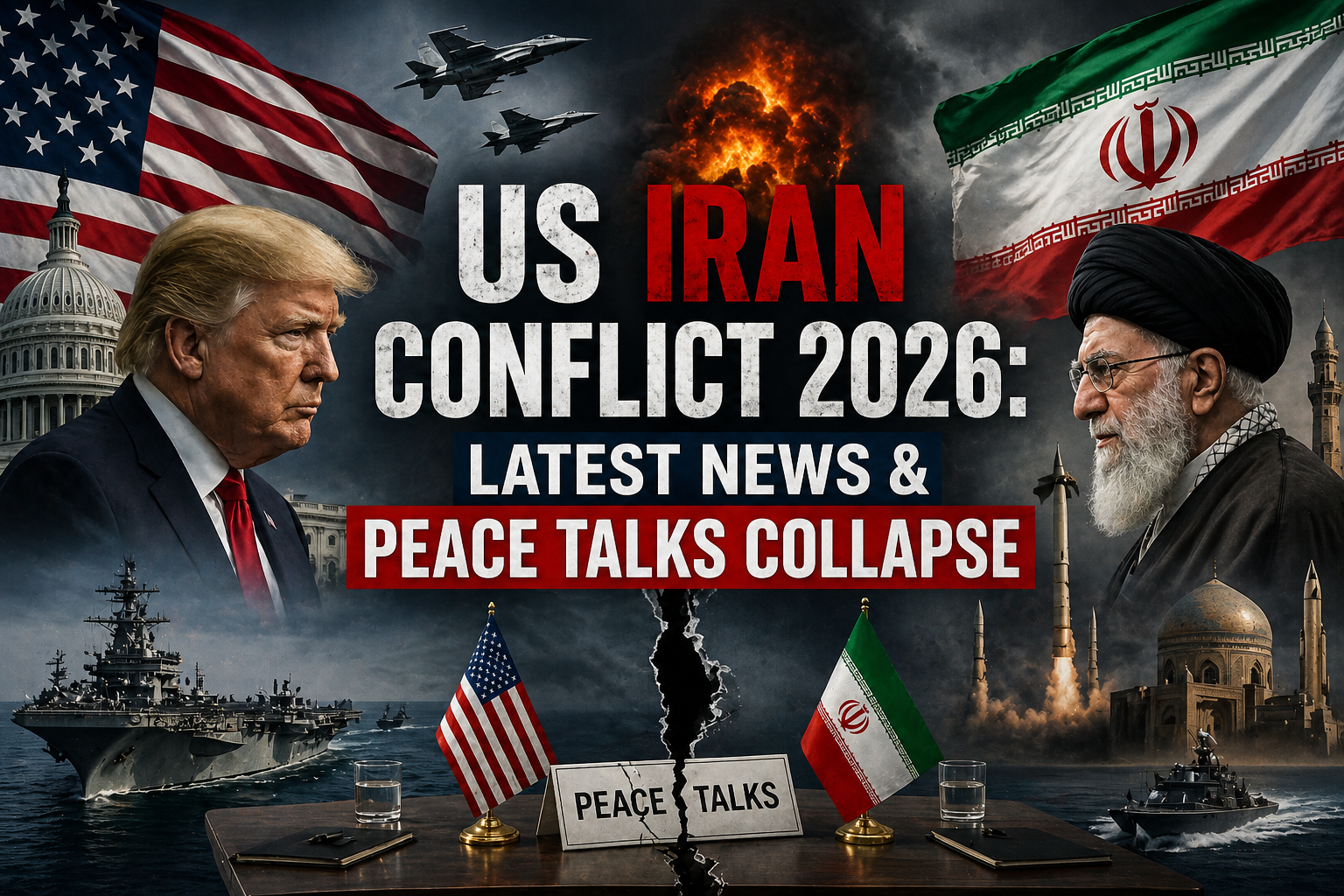
The US Iran conflict in 2026 has become the most consequential geopolitical crisis of this decade. What started as a military confrontation in late February 2026 has now evolved into a tense diplomatic standoff — with peace talks on the brink of collapse, the Strait of Hormuz still choked by blockades, and global oil markets in a state of sustained shock. As of April 27, 2026, the ceasefire remains technically in place, but the situation is fragile.
If you are trying to understand what is actually happening with the US Iran war latest news, you are in the right place. This deep-dive covers everything — from how the conflict started, to where the nuclear talks stand today, to what the world can expect next. We have broken it down into simple, clear sections so anyone can follow the situation, no matter how much background knowledge they have.
38
Ships Turned Back by US Blockade
3
US Aircraft Carriers in Middle East
$200
Worst-Case Oil Price Per Barrel (Analyst Estimate)
2,000+
Civilians Killed in Lebanon Escalation
How the US Iran Conflict 2026 Actually Started
To understand the US Iran conflict latest news, you need a little background. The roots of this war go back decades — but the modern flashpoint was the assassination of Iran’s top military commander Qasem Soleimani in January 2020 by US forces under Trump’s first term. After the October 7, 2023 Hamas attacks on Israel, Iran-backed proxies — Hezbollah, the Houthis, and various Iraqi militias — began ramping up operations across the region.
Then in late February 2026, the United States and Israel launched coordinated air strikes on Iranian military infrastructure. The strikes were so precisely timed that senior Iranian commanders were caught off guard, gathering in person in groups that became direct targets. The opening salvo eliminated key figures in Iran’s military chain of command and severely damaged its air defense networks, missile production sites, and nuclear facilities.
Iran responded with hundreds of drones and ballistic missiles targeting Israel and US military bases across the Gulf — in Bahrain, Jordan, Kuwait, Qatar, Saudi Arabia, and the UAE. The conflict quickly spread. A drone struck Britain’s Akrotiri base in Cyprus. An Iranian missile entered Turkish airspace and had to be intercepted by NATO’s air defense systems. The US Iran war in 2026 had gone fully regional within days of starting.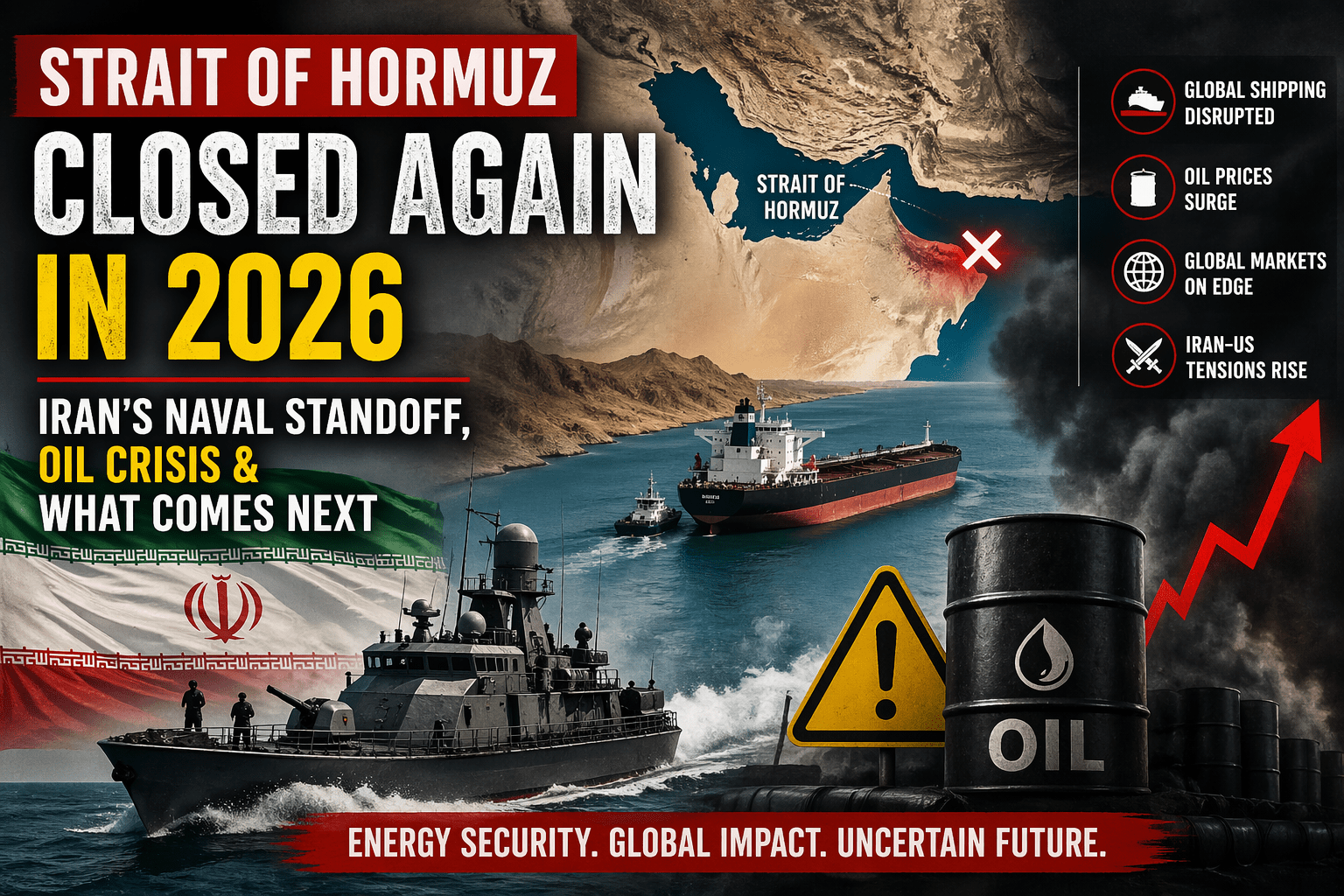
The Strait of Hormuz crisis — Iran’s IRGC blockade has disrupted roughly 20% of the world’s seaborne oil supply. | DailyUpdates360
The Strait of Hormuz Blockade: Why It Matters to the Entire World
No single issue in the US Iran conflict 2026 has had a bigger impact on the global economy than the closure of the Strait of Hormuz. This narrow waterway — just 33 kilometers wide at its narrowest point — carries roughly 20 million barrels of oil per day and accounts for about 20% of all global seaborne oil. When it closes, the world feels it almost immediately at the petrol pump.
On April 18, 2026, Iran’s Islamic Revolutionary Guard Corps (IRGC) announced a full blockade of the strait. The US responded with its own counter-blockade, directing ships away from Iranian ports. To make matters worse, Iran reportedly lost track of some mines it had planted in the Strait — the US Navy is currently running mine-clearing operations to restore navigation safety. As of this week, only a handful of crossings have been reported, according to MarineTraffic data.
🛢️ Economic Impact: Goldman Sachs and other major banks now project oil prices could reach $120–$200 per barrel in a worst-case scenario if the Strait remains closed beyond 60 days. That would trigger inflation spikes and potential recessions across Europe, Asia, and the developing world.
Read our full breakdown: Strait of Hormuz Closed Again in 2026: Why It Happened & What Comes Next — and for the oil investment angle, see our guide on Best Oil Stocks to Buy Now in 2026.
US Iran Ceasefire 2026: A Timeline of What Has Happened
The path from full-scale conflict to today’s fragile ceasefire has been anything but straightforward. Here is a clear timeline of the US Iran war ceasefire 2026 and the key events that shaped it:
February 25, 2026
US Treasury imposes sweeping sanctions on 30+ Iranian oil network entities — the economic campaign dubbed “Economic Fury” begins.
Late February 2026
US and Israel launch surprise coordinated strikes on Iran, eliminating multiple senior IRGC commanders. Iran fires back with hundreds of drones and missiles at US bases across the Gulf.
March 31, 2026
Pakistan and China jointly deliver a 5-point peace initiative calling for immediate ceasefire and restoration of Hormuz navigation.
April 7–8, 2026
Trump announces a two-week ceasefire brokered by Pakistan. Iran partially agrees but rejects the full US framework, issuing its own 10-point counter-proposal.
April 11–12, 2026
Direct 21-hour US-Iran talks held in Islamabad. Steve Witkoff and Jared Kushner represent the US side. Talks collapse over uranium enrichment — the US demands a 20-year freeze, Iran offers 3–5 years.
April 18, 2026
Iran’s IRGC announces a complete blockade of the Strait of Hormuz to international shipping. Global oil markets spike sharply.
April 21, 2026
Trump extends the Iran truce to allow Iran more time to submit a revised peace proposal at Pakistan’s request.
April 24, 2026
For the first time since 2003, three US aircraft carriers — including the USS George H.W. Bush — are stationed simultaneously in the Middle East. Iran seizes a ship suspected of cooperating with US forces.
April 25, 2026
Trump cancels special envoys Witkoff and Kushner’s trip to Pakistan, saying Iran’s proposal “was not good enough.” He says talks will continue by phone — the US “has all the cards.”
April 26–27, 2026
Iran’s FM Araghchi visits Oman and Pakistan, then departs for Moscow to meet Putin. Russia reiterates its offer to store Iran’s enriched uranium. Hormuz shipping remains near-standstill.
Why the US Iran Peace Talks Collapsed in April 2026
The central disagreement in the Iran nuclear talks 2026 is deceptively simple: both sides agree Iran cannot have nuclear weapons, but they cannot agree on how to prevent it. The US demands Iran shut down or freeze its uranium enrichment program for at least 20 years. Iran, whose enrichment capability is one of its last major geopolitical leverage points, has offered only a 3-to-5-year freeze — after which it wants full sovereignty over its nuclear program restored.
The US proposal also includes limits on Iran’s ballistic missile program, a reopening of the Strait of Hormuz, an end to Iranian support for armed proxy groups (Hezbollah, the Houthis, Iraqi militias), and sanctions relief in exchange. Iran’s counter-proposal includes an end to all US and Israeli attacks, security guarantees, war reparations, and full lifting of sanctions — with no binding restrictions on its nuclear program beyond the short-term freeze.
Why Trump Canceled the Pakistan Trip
On April 25, President Trump made a dramatic decision — he canceled his envoys’ scheduled trip to Islamabad just hours before they were due to depart. Speaking to reporters, Trump said Iran’s latest proposal “was not good enough” and that the US would handle negotiations by phone going forward. “We have all the cards. They can call us anytime they want,” he said, adding that lengthy flights were not worth taking for fruitless talks.
⚠️ Diplomatic Warning: Republican Senator Lindsey Graham praised Trump’s decision to cancel the trip, calling it “very wise” and stating that resuming military operations may be required if Iran does not comply. This signals a hard-line shift in Washington’s stance.
For background on how the talks broke down earlier in April, read our detailed coverage: Iran US Nuclear Talks 2026: Latest News, Islamabad Ceasefire Crisis & What Happens Next.
Russia and China’s Role in the US Iran Conflict
One of the most significant — and underreported — dimensions of the US Iran conflict is the involvement of Russia and China as diplomatic counterweights to American pressure. Russia has positioned itself as Iran’s primary diplomatic ally throughout the conflict. Moscow’s Foreign Minister Sergey Lavrov has repeatedly called US and Israeli strikes “unprovoked aggression,” and Russia has offered to physically take custody of Iran’s enriched uranium — storing or reprocessing it on Russian soil as part of any peace deal.
Trump has reportedly rejected Russia’s offer, wary of giving Moscow more leverage in global nuclear energy markets. China, meanwhile, has co-sponsored a 5-point peace framework with Pakistan and has opposed every round of US sanctions on Iran, as it has done since the 2015 nuclear deal era. Iran Foreign Minister Araghchi is now heading to Moscow after his Pakistan and Oman visits — underscoring that Russia will be deeply involved in any eventual settlement.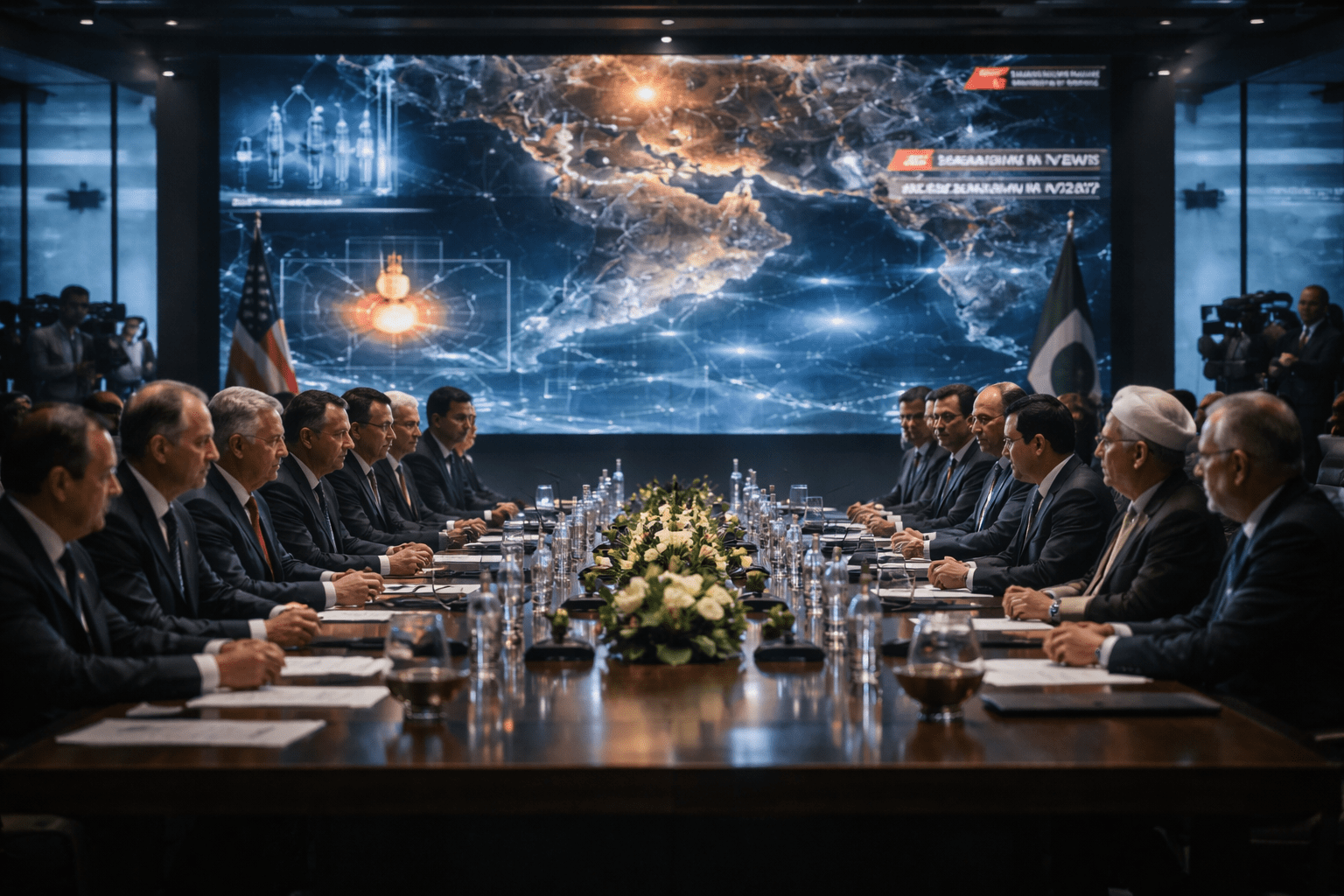
US-Iran negotiators during the Islamabad talks, April 12, 2026. The 21-hour session ended without agreement. | DailyUpdates360
What Is at Stake: Nuclear Weapons, Oil Supply, and Regional Security
The US Iran war 2026 is not just about two countries — it touches every nation on the planet. Here are the three core stakes that make this conflict so globally significant:
1. Iran’s Nuclear Program
Iran’s uranium enrichment capability is at the heart of this entire confrontation. The US-Israeli strikes specifically targeted nuclear infrastructure. If Iran does not agree to verifiable restrictions, analysts warn Tehran could still reconstruct enough capability to produce nuclear weapons within a matter of months. This is the scenario the US and Israel went to war to prevent — and it remains an open question whether the military campaign has permanently set it back or simply delayed it.
2. Global Energy Supply
With 20 million barrels of oil per day flowing through the Strait of Hormuz under normal conditions, any prolonged blockade directly impacts energy costs worldwide. Europe, South Asia, East Asia, and much of the developing world depend on Gulf oil. A price spike to $150–200 per barrel would be catastrophic for inflation and economic growth globally. This is why the UK’s Prime Minister Starmer and Trump discussed the “urgent need” to reopen the sea lanes in a direct call this week.
3. Middle East Regional Stability
The 2026 Lebanon war — a direct spinoff of the US-Iran conflict — has already killed more than 2,000 civilians and combatants. Hezbollah, Hamas, the Houthis, and Iranian-backed Iraqi militias all remain active. Israel has continued strikes in Lebanon. A full collapse of the ceasefire could see the region spiral into a multi-front war that no single country can contain alone.
What Happens Next in the US Iran Conflict?
Three scenarios are realistic as of late April 2026, according to analysts and diplomatic observers:
- Scenario A — Phone Diplomacy Works: Iran submits a revised proposal that satisfies key US demands (particularly on enrichment limits and Hormuz). Talks resume at a lower diplomatic level. A 45-day extended ceasefire framework is agreed. This is the optimistic path — and still possible if both sides want to avoid resuming strikes.
- Scenario B — Stalemate Continues: Neither side escalates, but neither makes meaningful concessions. The ceasefire holds technically, but blockades remain, oil prices stay elevated, and the humanitarian situation worsens. This is the most likely near-term scenario.
- Scenario C — Conflict Resumes: Trump authorizes limited resumption of strikes, potentially targeting Iranian power plants (previously postponed). Iran retaliates against Gulf infrastructure. Oil markets go into severe shock. This is the scenario global markets are pricing in as a tail risk.
For a detailed look at whether this could escalate further, read our analysis: US vs Iran War 2026: Will the Conflict Turn Into World War 3? Also see our companion piece on the Hormuz situation: Hormuz Crisis 2026: Iran’s Naval Blockade & Rising Oil Prices.
🔗 External Sources: For real-time diplomatic updates, follow Al Jazeera’s Iran War Live Blog, CNN’s Iran War Live Updates, and the UK House of Commons Library Briefing on the US-Iran ceasefire for an authoritative policy perspective.
Final Thoughts: The US Iran Conflict Is Far From Over
The US Iran conflict in 2026 is one of those rare geopolitical events that reshapes the world regardless of how it ends. If the ceasefire holds and a deal is eventually reached, the Middle East enters a new era of negotiated security frameworks — one that includes constraints on Iranian nuclear ambitions in exchange for lifting sanctions. If it fails, the region slides deeper into chaos, oil markets stay volatile, and the risk of miscalculation escalating into something far worse becomes very real.
What is clear right now is that the world cannot afford to look away. The Iran nuclear talks 2026 will determine not just the fate of one nation, but the shape of global energy security, regional stability in the Middle East, and the rules of international diplomacy for years to come. Stay informed — because what happens in the next few weeks matters to every one of us.
This article will be updated as developments unfold. Bookmark DailyUpdates360 World News for the latest coverage.
US Israel Iran War 20262026 War UpdatesConflict NewsHumanitarian CrisisUkraine War Update
Frequently Asked Questions About the US Iran Conflict 2026
What is the current status of the US Iran conflict in 2026?
As of late April 2026, the US-Iran conflict is in a fragile ceasefire. The truce that began on April 8 has technically expired, though neither side has resumed full-scale strikes. Peace talks stalled after Trump canceled his envoys’ Islamabad trip on April 25. Iran’s FM Araghchi is now in Moscow seeking Russian diplomatic backing.
Is the Strait of Hormuz still closed in 2026?
Yes. As of late April 2026, the Strait of Hormuz remains severely restricted to shipping. Iran planted mines in the waterway, and the US Navy is conducting mine-clearing operations. The US blockade has turned back 38 ships from Iranian ports, and only a handful of vessel crossings have been reported recently.
Why did Trump cancel the US-Iran peace talks trip to Pakistan?
Trump canceled special envoys Steve Witkoff and Jared Kushner’s planned trip to Islamabad on April 25, 2026. He stated Iran’s negotiating proposal was “not good enough” and that he refused to spend 18 hours on flights for unproductive talks. He said negotiations would continue by phone, and that the US “has all the cards.”
What does Iran want in the nuclear deal negotiations?
Iran’s key demands include an end to US and Israeli strikes, binding security guarantees against future attacks, war reparations, full lifting of all sanctions, and international recognition of its sovereignty over the Strait of Hormuz. Iran has rejected permanent restrictions on its nuclear enrichment program, offering only a 3-to-5-year temporary freeze.
© 2026 DailyUpdates360 — All Rights ReservedWorld News | Privacy Policy | Contact Us
🔗 Related Articles
 US vs Iran War 2026: Will It Turn Into World War 3?
 Iran US Nuclear Talks 2026: Islamabad Ceasefire Crisis
 Strait of Hormuz Closed 2026: Why & What Comes Next
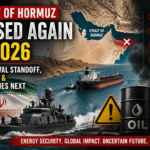 Hormuz Crisis 2026: Iran’s Naval Blockade & Oil Prices
📊 Conflict Quick Facts
🗓 War began: Late Feb 2026
🕊 Ceasefire: April 8, 2026
🚢 Ships blocked: 38+
✈️ US carriers: 3 in Middle East
🛢 Oil at risk: ~20M barrels/day
🌍 Mediator: Pakistan
🇷🇺 Iran’s ally: Russia + China
🌐 Follow World News
Stay updated with breaking world news every day.🌍 World News Hub💹 Best Oil Stocks 2026